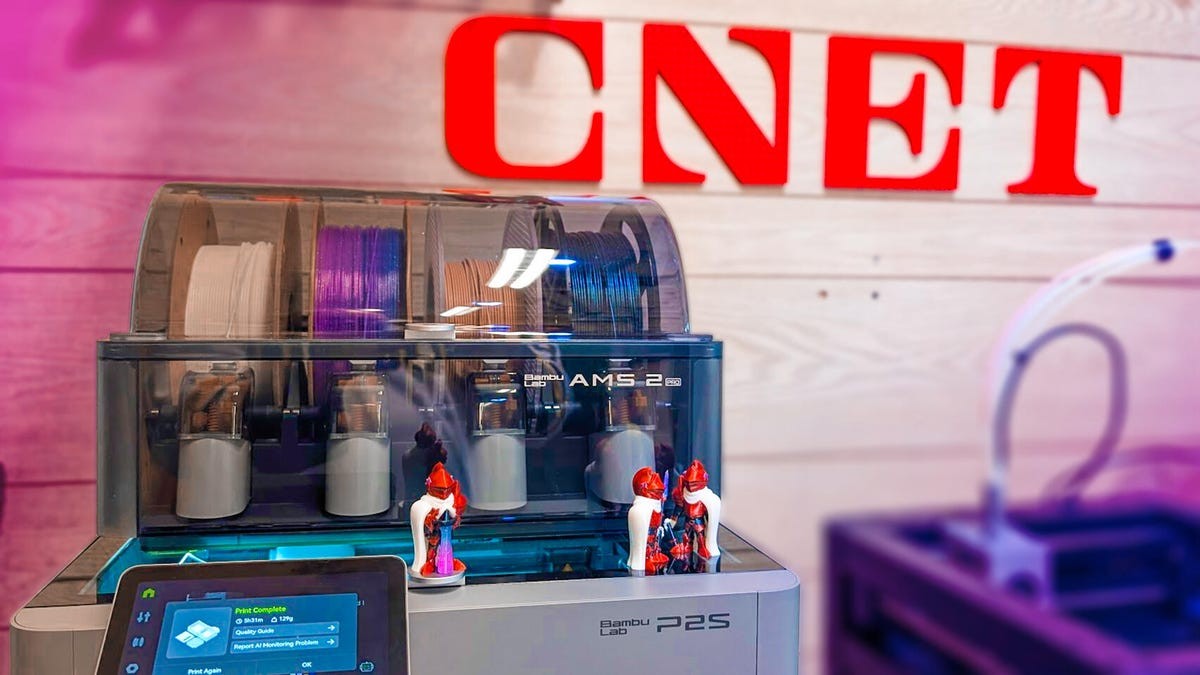
Bambu Lab’s P2S is a significant upgrade in the desktop 3D printing market, earning a CNET Editors’ Choice award for its blend of performance, reliability, and user-friendliness. This machine doesn’t reinvent the wheel, but rather refines an already excellent platform—the P1S—into a nearly perfect package for both enthusiasts and professionals.
Incremental Improvements, Maximum Impact
The 3D printing industry has matured to the point where established brands like Bambu Lab now deliver predictable, high-quality product cycles. The P2S exemplifies this trend: it’s an evolution, not a revolution, building upon the strengths of its predecessors while addressing key areas for improvement.
The P2S borrows heavily from Bambu Lab’s flagship X1 Carbon, but at a more accessible price point. Carbon fiber rods, a hallmark of the X1C, have been replaced with durable steel equivalents, reducing cost without sacrificing performance. This makes the P2S a compelling value proposition: it delivers near-X1C capabilities for less.
Enhanced Mechanics and Performance
Bambu Lab didn’t just cut corners; they upgraded vital components. The P2S features a redesigned hot end, incorporating the magnetic servo extruder from the high-end H2D model. This increases extrusion force by 70%, allowing faster and more reliable filament feeding. Paired with a hardened steel nozzle (also from the H2D), the printer can handle a wider range of materials with greater precision.
Cooling has also been dramatically improved. The P2S utilizes an adaptive airflow system, pulling in fresh air for cooler filaments like PLA while venting heat from warmer materials. This eliminates the need to keep the printer door open during printing, maintaining consistent temperatures and print quality.
Real-World Testing and Results
The P2S excels in real-world testing. CNET’s tolerance tests showed snug but not fused parts, sharp details with no stringing, and clear, readable text. The machine handles high-speed printing without the vibrations that plague other models, making it a true workhorse. The printer’s ability to handle complex geometries, deep overhangs, and multiple models in a single print bed is remarkable.
Multicolor printing is seamless. The P2S is compatible with both the original AMS and the newer AMS2, allowing for eight-color setups with minimal effort. For those who want even more flexibility, up to four AMS units can be connected, enabling a maximum of 20-color printing (at a considerable cost).
Waste and Efficiency
While the P2S excels in performance, it doesn’t entirely solve the problem of material waste. Multicolor prints, in particular, generate significant excess material. Printing in batches can mitigate this issue, but it remains a trade-off between color complexity and resource consumption.
User Experience
Bambu Lab has also upgraded the user interface. The P2S features a large LCD screen with the latest Bambu Lab software, a substantial improvement over the P1S’s outdated display. The overall experience is polished, intuitive, and easy to use, even for beginners.
The P2S doesn’t just iterate on previous models; it consolidates the best features from across Bambu Lab’s product line into a single, powerful, and affordable package.
Conclusion: The Bambu Lab P2S is more than just an incremental upgrade. It’s a refined, high-performance 3D printer that delivers exceptional value and sets a new standard for desktop manufacturing. Whether you’re a seasoned maker or just starting out, the P2S is a compelling choice that will deliver years of reliable performance.