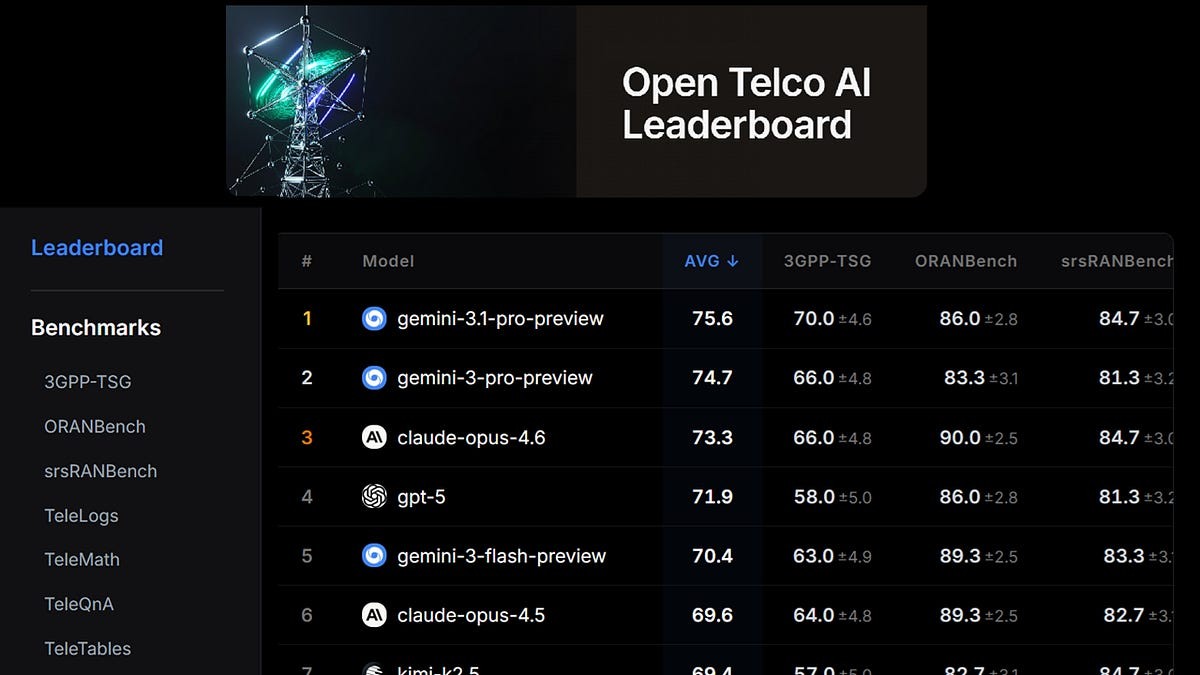
The global telecommunications industry now has a more robust method for evaluating large language models (LLMs) tailored to its unique needs. The GSMA, in collaboration with Khalifa University and Huawei Paris Research Centre, has released the third iteration of the Open Telco AI Leaderboard at Mobile World Congress (MWC) Barcelona. This open benchmark platform ranks LLMs specifically for telecom applications, addressing a critical gap in the industry.
Why This Matters: A Complex Domain Needs Clear Metrics
Telecommunications is notoriously complex from an AI perspective. Developing models that can handle network operations, customer service, and highly specialized technical tasks requires precise benchmarks. Without them, progress is slow, and comparing different LLMs becomes subjective. The Open Telco AI Leaderboard provides the clarity the industry needs. It moves the field from guesswork to measurable results.
What’s New in Release 3?
This latest version expands the benchmark to include tasks mirroring real-world operator workflows. It tests LLMs on key telecom-specific attributes:
- Precision in answering technical queries.
- Mathematical reasoning for network calculations.
- Performance in network operations scenarios.
- Energy efficiency, vital for large-scale deployments.
The platform also supports evaluation of methods like fine-tuning and retrieval-augmented generation (RAG) for applications such as customer service chatbots and network configuration tools.
A Collaborative Ecosystem
The Open Telco AI Leaderboard is part of the broader OpenTelco AI initiative, launched at MWC Barcelona. This initiative aims to create an open foundation for telco-grade AI, including models, datasets, and collaborative development. Founding partners include AT&T (releasing open telecom AI models) and AMD (providing compute capacity through GPUs and TensorWave).
The Digital Future Institute (DFI) at Khalifa University is a key contributor, leading the Network Management and Configuration Group within the Open Telco AI programme. The DFI has already contributed telecom-specific models like RF-GPT (for radio frequency applications) and TelecomGPT-R1 to the ecosystem.
The Open Telco AI Leaderboard isn’t just about ranking models; it’s about building a shared, open foundation for the future of AI in telecommunications.
The release of this leaderboard signals a shift towards standardized, verifiable AI development in a sector that has long lacked clear evaluation criteria. This will accelerate innovation and help operators deploy more effective AI solutions.
This initiative is a critical step toward a more efficient and reliable AI-powered future for the global telecom industry.