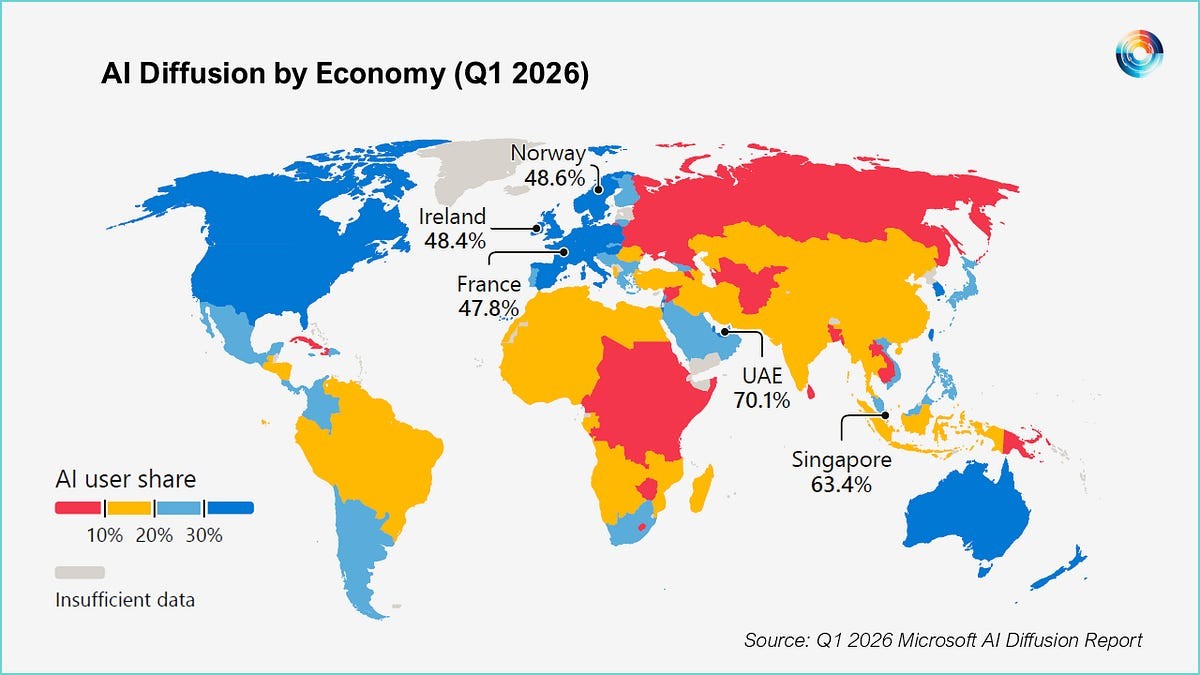
The United Arab Emirates has solidified its status as the global frontrunner in artificial intelligence integration, with 70.1% of its working-age population utilizing generative AI tools by the end of the first quarter of 2026. According to the latest data from the Microsoft AI Economy Institute (AIEI), this figure represents a significant 6.1 percentage point jump from the previous half of 2025, demonstrating an acceleration in adoption that is outpacing the rest of the world.
This surge is not merely a statistical anomaly; it reflects a deliberate, state-led strategy that has allowed the UAE to pull further ahead of its nearest competitors. While global adoption rates have ticked up, the gap between early adopters and the rest of the world is widening, raising critical questions about digital equity and economic competitiveness.
The Gulf’s Technological Leadership
The UAE’s dominance is most visible when compared to its regional and global peers. The nation has extended its lead over second-place Singapore from a narrow 3 percentage points to nearly 7 percentage points. This widening margin underscores the effectiveness of the UAE’s comprehensive approach, which combines early government commitment, regulatory pragmatism, and heavy investment in digital infrastructure.
The broader Gulf region is emerging as a concentrated hub for high AI adoption. Qatar maintained its position as the 10th highest-ranked nation globally, with an adoption rate of 41.8%, up from 38.3% in late 2025. These figures confirm that the Middle East is not just keeping pace with technological trends but is actively shaping them through coordinated policy and infrastructure development.
A Widening Global Gap
While the UAE and Qatar accelerate, the global picture reveals a stark divide. Overall, AI usage among the working-age population rose from 16.3% to 17.8% during Q1 2026. However, this aggregate growth masks significant disparities between different parts of the world.
- The Global North: Adoption reached 27.5%, increasing by 2.8 percentage points.
- The Global South: Adoption stood at just 15.4%, with a modest increase of 1.3 percentage points.
The primary constraints in the Global South remain fundamental: limited access to reliable electricity, internet connectivity, and digital skills training. Consequently, the technological gap between developed and developing nations continues to expand, potentially exacerbating existing economic inequalities.
Key Insight: The United States, despite its technological prowess, ranks 21st globally with a 31.3% adoption rate. This figure is less than half of the UAE’s rate, highlighting that cultural and regulatory environments play as large a role in AI adoption as technological capability.
AI in Software Development: Expansion, Not Replacement
One of the most significant trends in the latest report is the transformation of software development. The quarter saw a dramatic acceleration in AI-assisted coding, with global Git pushes (a metric for developer activity) increasing by 78% year-on-year. This surge is driven by advanced tools such as Anthropic’s Claude Code, OpenAI’s Codex, and Microsoft’s GitHub Copilot.
Contrary to widespread fears that AI would lead to massive job losses in the tech sector, the data suggests the opposite. US developer employment reached a record 2.2 million in 2025, an 8.5% increase year-on-year. Early data from March 2026 shows employment levels approximately 4% higher than the same period in 2025.
This indicates that AI coding tools are currently acting as force multipliers, expanding the scope of what developers can achieve and thereby increasing demand for their skills, rather than replacing them.
Policy as the Engine of Adoption
The UAE’s success is rooted in policy decisions made nearly a decade ago. In 2017, the UAE became the first country to appoint a Minister of State for Artificial Intelligence, signaling a long-term commitment to embedding AI into the fabric of society and governance.
Since then, the government has systematically integrated AI into performance metrics, planning, and legislation. Notable achievements include:
* The world’s first AI-powered Proactive Government Performance System, which tracks over 150 million data points monthly.
* A new framework announced in April 2026 to deploy agentic AI across 50% of government sectors and services within two years.
No other government has moved with this speed or scale, demonstrating that political will and strategic planning are just as critical as technology in driving adoption.
Conclusion
The UAE’s 70.1% AI adoption rate is a testament to the power of coordinated national strategy in the digital age. As the gap between AI leaders and laggards widens, the data suggests that early investment, clear regulatory frameworks, and infrastructure development are the key differentiators. While AI tools are reshaping industries like software development by boosting productivity and employment, the global divide remains a pressing challenge that requires focused international attention.