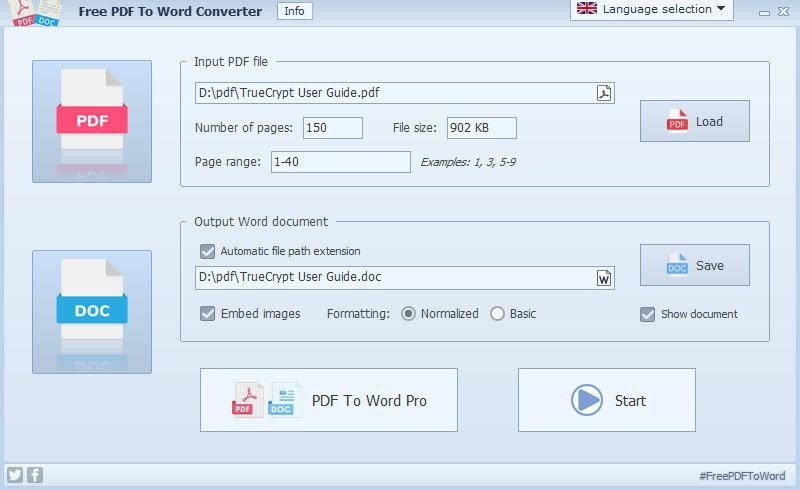
Open the PDF. I want to edit the text. You can’t. Locked. Or scanned. Or it’s just stubbornly formatted in a way that Word doesn’t like. This is where Free PDF to Word Converter comes into play. It’s a utility built specifically for Windows that does one thing: convert plain PDF files into editable Word documents, and it tries to do it well. No fluff. Does not require a complex technology stack. Just select a file, adjust a setting or two and start the engine.
The user interface is very clean. It doesn’t feel like enterprise software in 2012. Drag, drop and click to convert. That’s the promise. For professionals tasked with dealing with contracts, reports or invoices, the ability to actually make changes to content is paramount. The tool will fail if the converted Word document is left designed by a madman.
How much formatting is retained?
This is the technical core of the software. It’s not just about extracting text. This is to preserve the soul of the document. Images. table. font. layout. The converter tries to connect these elements directly to Word structures. This is very important when working with documents created on a scanner rather than documents created in a digital editor. The tool claims to handle both cases and aims to high fidelity of its results.
Why is this important? Because no one wants to spend hours manually re-typing a report or rebuilding complex tables in Word. You can save time if the transformation preserves the visual hierarchy. You save sanity. The software is designed so that you can edit the resulting file instantly, including updating dates, renaming, and adding comments.
Speed, batch processing, privacy
Conversion speed is often an issue. I have a folder full of files. I don’t want to do it one thing at a time. Free PDF to Word Converter supports batch processing. You can queue dozens of files and let it work. This is a simple feature, but a big time saver for heavy users.
Moreover, it also works offline. No internet connection required. This is not only convenient; This is a security feature. Sensitive data (financial documents, legal documents, personal data) remain on your computer. It is not uploaded to cloud servers where it can be stored or analyzed. For privacy-conscious users, this local approach is a huge advantage. It’s free, fast and in control of your data.
Download and install on Windows
Getting the software is very easy. It can be downloaded from Futura-Sciences. Go to the page, find the button and follow the instructions. No need to create an account. There is no email confirmation. No “free for 14 days” trial that cuts you off. This is just an installer. This lack of friction lowers barriers to entry significantly. Available to students, teachers and professionals of all fields without financial burden or technical gatekeeping.
Installation is standard Windows fare. Run the executable file. Accept the terms. Click Next until you’re done. Quietly integrated into your system. There is one thing to note. This tool does not work well in non-Windows environments. There are no native versions for MacOS, Linux, Android or iOS. If you’re on a Mac, you’re out of luck unless you spin up a Windows virtual machine or look elsewhere. It is strictly a Windows utility and supports versions from Windows 7 to Windows 11. The developers ensure compatibility with multiple iterations of operating systems so that it can be used on older computers.
Compatibility and integration
Does it break your existing setup? Not likely. This software is designed to work together with other office suites. It doesn’t conflict with Microsoft Office or LibreOffice. You can have Word, LibreOffice Writer and Converter in the same workspace without any problems. This compatibility is important for users who don’t want to replace their current toolkit, but only need specific utilities to perform specific tasks.
If you are looking for updates or older versions, the official Futura-Sciences page is your hub. Keep the download links up to date and list the available versions. This is a practical approach. There are no mystical updates. There will be no forced migration. Only use the tools you need when you need them.
The world of file conversion is very crowded. Tools come and go. Some people promise the world and take the garbage home with them. Focus on this. Solve a specific problem for a specific audience. Windows users tired of struggling with locked PDF files now have a direct path to editable content. No cloud. No accounts. Just files.
Is it perfect? Probably not. No tool is. But it still works when it comes to the core task of easily converting PDF files to Word. Its offline nature alone makes it a viable option for those working with sensitive data. The batch processing handles volume. Maintaining the layout ensures quality. This is a practical solution in a market often cluttered with bells and whistles.
However, you will have to deal with occasional formatting errors. Scanned documents can be difficult to process. Complex tables are subject to change. However, this is a significant improvement over the alternative manual rewrite. It’s not a question of do you need it. The question is, am I constantly wasting my time on files that should be edited?
Why local processing is important in PDF conversion
Most free PDF-Word tools work in a cloud model. When you upload a file, the server processes it and you get a download link. it works. It is very convenient. However, this causes friction. An active Internet connection is required. Conversion restrictions are often encountered. When your documents are on someone else’s server, there’s always the question of where they actually went.
Free PDF to Word Converter follows a different path. Works locally. to your machine. There are no cloud dependencies. The difference is not only in privacy, but it is a big advantage. It’s speed and reliability. If the internet goes down during the download process, the Cloud Converter will fail. A local converter doesn’t even notice.
This tool strips away the fluff. There is no watermark on the page. Plain text does not have the “converted by [Service Name]” headers. You will receive an original, functional Word document. This is important if you want to edit a contract, resume or report to look professional instantly.
Simplicity beats feature bloat
Adobe Acrobat is the industry standard for a reason. Merge, sign, encrypt and optimize PDF files. Smallpdf offers a smooth user interface and a number of useful tools. But it’s heavy. They are suites.
The converter is a scalpel, not a swiss army knife. It does one thing. Convert PDF to Word. It keeps the formatting as faithful to the original as possible and handles images, multiple columns and complex graphics with incredible accuracy. This is an advantage for users who do not need to merge 50 documents into one or use digital signatures. It is very light. It is very fast. It doesn’t force you to subscribe.
If your workflow requires advanced PDF processing, you need a more efficient, paid solution. For people who just want to download software and open files in Word, this tool is perfect.
Updates and incompatibilities
There is a catch. The software is not updated automatically. Still have to check. This is a common feature of niche freeware. To make sure you’re running the latest stable version, you need to go to the source, usually a trusted tech portal like Futura-Sciences. Security matters, and outdated executables can pose a risk.
This manual method also opens the door for legacy users. If you have an older computer and the latest version is slow, you can usually find older executables online. Compatibility is a big concern for users running Windows 10 or 11 on older devices. Although the latest versions are optimized for modern performance, the availability of older versions provides a safety net.
No Certification Needed
No official certification courses were found for this tool. It doesn’t need one. The user interface is very intuitive. Most users will figure it out in a few seconds. There is definitely a learning curve, but it is low.
However, tutorials do exist. Guides from tech sites like Futura-Sciences offer tips for optimizing the conversion of tricky documents, especially those with dense layouts or embedded fonts. These resources are not required, but they will help you achieve better results.
Free PDF to Word Converter Verdict
It has a specific niche. This is not the most powerful tool on the market. It’s not the most feature-rich. But in a clean, unwatermarked original conversion, it stands out.
It’s free and works natively, eliminating two of the biggest friction points for online converters: privacy and connectivity. Downloading from a trusted source provides an extra layer of security that random “free converter” sites don’t have.
This is a practical tool. It promises nothing to the world. It promises a clean Word file, fast. For many people, this is exactly what they need. It’s not a question of whether it’s the best tool ever. What matters is whether it is good enough for the next document. Spoiler: Yes.
How Free PDF to Word Converter Handles Local File Transformation
Most online converters are essentially data traps. You upload a sensitive contract, it hits a server somewhere in the cloud, and you hope it vanishes after the conversion. Free PDF to Word Converter flips that model. It runs locally. The processing happens on your machine, not on a distant server. This matters for anyone handling confidential documents or working with limited bandwidth. No internet connection is required for the actual conversion. You keep your data. You keep your privacy.
The software targets a specific gap in the market. It is not a full-blown word processor. It does not try to replace Microsoft Word or LibreOffice. Instead, it focuses on one thing: turning a static PDF into an editable document without breaking the layout. If you have a report filled with tables, images, and specific font choices, this tool aims to preserve that structure during the transition. The fidelity of the layout is the main selling point. It tries to keep the images where they belong and maintain the table structures intact.
System Requirements and Installation Details
This is a desktop application for Windows. It is not a web-based tool. You need to download the .exe installer and run it on your computer. It supports both 32-bit and 64-bit architectures, which covers almost every Windows machine in use today. The supported operating systems include Windows 7, 8, 8.1, 10, and 11.
Installation is straightforward but requires administrative rights. You will go through a step-by-step wizard. It is not a portable app. It installs into the system, meaning it lives in your start menu and program files just like any other software. The interface is graphical and straightforward. It is primarily designed in English, though specific editions might offer other languages. The logic is simple: select a PDF, choose settings, and get a Word file.
What Can It Convert?
The input format is strictly PDF. It handles PDFs that contain text as well as those that are image-based. However, there is a catch with the image-based ones. The software does not guarantee Optical Character Recognition (OCR). If your PDF is a scan of a printed page with no underlying text layer, you likely won’t get editable text. You will get an image of that text. For those cases, you would need an external OCR module or a different tool.
The output is designed to be compatible with Microsoft Word. You will get a .DOC file. Depending on the specific version or edition of the software, you might also get .DOCX or .RTF formats. These files can be opened in Microsoft Word, but they also work in compatible suites like LibreOffice Writer. This cross-compatibility is useful if your workplace uses open-source software but your clients send you PDFs meant for corporate environments.
Batch Processing and Limitations
One of the stronger features for power users is batch processing. You are not limited to converting one file at a time. You can queue up multiple PDFs and let the software handle them in sequence. This is a significant time-saver for administrative staff or students who need to process large volumes of documents.
But it is not magic. It has clear limitations. It does not modify the original PDF files. It creates new files. It cannot remove password protection. If a PDF is locked, this tool will not break the security for you. It also lacks advanced editing features. It is not a tool for rewriting content or designing new layouts. It is a converter. If you need to significantly restructure a document or edit complex forms, you will still need to do that work in Word after the conversion.
Who Is This For?
The target audience is broad but specific in its needs. Individuals, students, and small to medium-sized enterprises (SMEs) benefit most from this approach. Administrative services that deal with paper records digitized as PDFs find it particularly useful. The key factor is the desire for speed and local processing. If you need to quickly extract text from a PDF to edit a report or reuse formatting in a new document, this fits the bill.
It is a simple solution for a common problem. No registration is needed. No cloud dependency. Just install it and convert. For users who deal with scanned documents, the lack of built-in OCR is a hurdle. But for standard PDFs with text layers, it offers a direct path from static to editable. The trade-off is clear: you get simplicity and privacy, but you lose the advanced editing and OCR capabilities that more complex, often paid, suites might offer. It is a functional, no-nonsense utility. Nothing more.