The Middle East is rapidly emerging as a global leader in the integration of Artificial Intelligence within the workplace. According to the PwC Middle East Workforce Hopes and Fears Survey 2025, three-quarters of the regional workforce has utilized AI tools in the past year—a figure that significantly outpaces the global average of 69%.
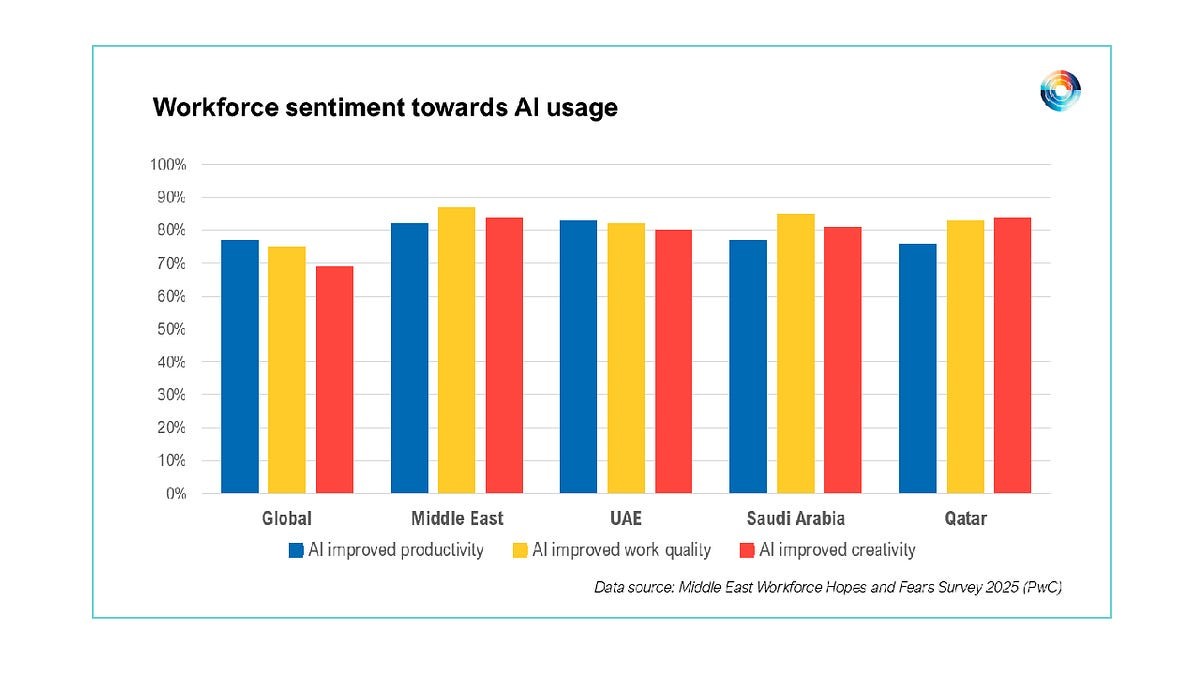
This surge in adoption is not merely about tool usage; it is translating into tangible professional benefits. Regional employees report higher levels of productivity, creativity, and work quality than their international peers, signaling a profound shift in how work is being performed across the Gulf.
A Regional Leader in Digital Transformation
The data highlights a high level of engagement across key markets in the region, particularly in the UAE, Saudi Arabia, and Qatar.
- United Arab Emirates (UAE): 72% of employees use AI at work, with 83% reporting productivity gains. This high adoption rate aligns with the ambitions of the UAE National Artificial Intelligence Strategy 2031.
- Saudi Arabia: 69% of the workforce uses AI. Notably, 55% of Saudi respondents believe AI will actually improve their job security, a stark contrast to the global average of 38%.
- Qatar: 69% of employees have integrated AI into their roles, with over 80% reporting improvements in work quality, productivity, and creativity.
Driving Efficiency and Creativity
The impact of AI on the regional workforce goes beyond simple automation. The survey reveals that Middle Eastern employees are seeing deeper qualitative benefits compared to the rest of the world:
- Productivity: 92% of regional respondents report improved productivity (vs. 77% globally).
- Work Quality: 87% report higher quality output (vs. lower global benchmarks).
- Creativity: 84% report enhanced creative capabilities.
This trend is largely driven by Millennials and Gen Z, who are adopting new tools more rapidly than older generations, positioning younger talent as the primary engines of digital transformation within their organizations.
The Human Element: Priorities and Pressures
Despite the technological optimism, the workforce is navigating complex socio-economic shifts. The survey identifies several critical trends regarding employee sentiment:
1. The Priority of Stability
Job security has become the paramount concern for the regional workforce, with 85% rating it as “very important.” Interestingly, there is a visible shift in career behavior: the percentage of employees planning to ask for pay rises dropped from 71% in 2024 to just 46% in 2025, suggesting a more cautious or security-focused approach to professional advancement.
2. The Skills Race
The Middle East workforce is prioritizing continuous learning. 69% of employees reported gaining new skills in the last year (compared to 56% globally), and 81% expressed a preference for roles that offer transferable skills.
3. The Risk of Burnout
The rapid pace of change comes at a cost. 45% of regional employees report feeling fatigued at least once a week, and nearly half feel overwhelmed. This creates a paradox: while engagement remains high—with 78% looking forward to work—the mental load of a rapidly evolving digital environment is mounting.
Strategic Alignment: From Employees to CEOs
The enthusiasm of the workforce is mirrored by leadership. Insights from PwC’s Global CEO Survey indicate that 82% of Middle East CEOs believe their organizational culture supports AI adoption. Furthermore, the region is ahead of the curve in practical application: nearly 40% of Middle East CEOs have already implemented AI for customer service and demand generation, compared to just 22% globally.
This alignment between employee usage and executive strategy is a primary driver behind the region’s economic performance, with Middle East businesses reporting an average revenue growth of 12%, outpacing the global average of 8%.
The Middle East’s rapid AI integration is not a coincidence; it is the result of coordinated national strategies and significant investments in digital infrastructure that have prepared the workforce to scale these technologies faster than most of the world.
Conclusion
The Middle East has successfully bridged the gap between AI potential and practical application, resulting in superior productivity and creativity. However, to sustain this momentum, leaders must address the rising levels of employee fatigue and the heightened demand for job security.