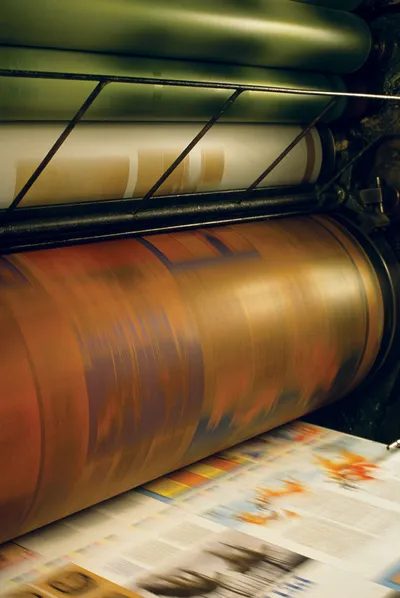
Most commercial print you touch likely came off a press that relies on a simple accident. Ira W. Rubel, an American printer in Nutley, New Jersey, stumbled upon the technique in 1904. His press picked up an image twice. The ink went from the plate to a rubber cylinder by mistake, then from the rubber to the paper. It worked better than the direct method he was trying to use.
This process defines offset printing, a cornerstone of commercial publishing. The inked image transfers from a plate to a rubber blanket, then to the substrate. The rubber is the key. It conforms to textures that rigid plates cannot. You can print on wood, cloth, metal, leather, or rough paper stock. The flexibility solves problems that other methods miss.
Planographic Precision
Offset printing is classified as planographic. This means the image sits flush with the plate surface. It is neither raised like letterpress nor sunk below the surface like intaglio or gravure. The distinction matters for quality control and material choice.
The technique evolved from lithography. It exploits the chemical fact that oil and water repel each other. A greasy ink adheres only to grease-treated areas on the plate. Nonprinting areas hold water. They reject the ink entirely. This separation keeps the image clean and sharp.
The Plate and the Chemistry
Modern offset plates are typically zinc or aluminum. Sometimes a combination of both. The surface is treated to be porous. Then it gets coated with a photosensitive material. You expose the plate to an image. The light hardens the coating on the printing areas. It washes away from the nonprinting areas. What remains is wetted metal ready to reject ink.
The plate itself is thin and lightweight. This allows for quick changes during a print run. Digital plates have largely replaced traditional chemical processing in many shops. But the core principle remains the same. Grease holds ink. Water pushes it away.
The Three-Cylinder Dance
A modern offset press has three main rotating cylinders.
- The Plate Cylinder: The metal plate attaches here. It receives moisture first.
- The Blanket Cylinder: This is covered by a sheet of rubber. It picks up the ink from the plate.
- The Impression Cylinder: This presses the paper against the blanket.
The sequence is precise. Moistening rollers deposit moisture into the granulations of the metal plate. Inking rollers follow. Water-holding areas reject the ink. Greasy image areas accept it. The inked image transfers to the rubber blanket. Finally, the paper, traveling around the impression cylinder, presses into the blanket. The image offsets to the paper.
This indirect transfer protects the plate. The rubber takes the wear instead of the metal. Plates last longer. Jobs run smoother.
Why It Still Matters
Digital printing dominates short runs. Offset still rules high-volume commercial work. The cost per unit drops significantly as quantity increases. Colors are vibrant. Consistency is high across millions of sheets.
You see the results everywhere. Magazines. Direct mail. Packaging. Books. The process handles different substrates with ease. The rubber blanket adapts to surface irregularities. Flatbed digital presses struggle with thick cardstock or textured fabrics. Offset handles them without missing a beat.
Is it outdated? Maybe. But it is efficient. And efficiency drives profit in printing