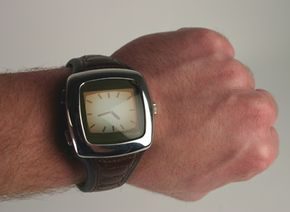
Smartphones swallowed the clock. That is the uncomfortable reality of modern life. You ask a friend the time and they pull out a phone, not a wristwatch. The analog timepiece, once the standard for punctuality, has become a decorative accessory for many. That shift created an opening that the latest wave of smart watches is trying to fill.
These are not the novelty calculator watches from elementary school. They are full-fledged digital tools that run apps, stream audio to Bluetooth headphones, and display data from touchscreens. Think compass readings, thermometer outputs, and calculator functions, all accessible on a band around your wrist.
The catch? Most of these watches are not standalone devices. They lack a direct internet connection. Instead, they rely on a tether to a smartphone. That phone provides the connectivity, which in turn unlocks the watch’s real potential: GPS navigation, calendar synchronization, and message notifications. A simple Bluetooth link allows you to answer calls or send texts without pulling your phone out of your pocket.
Specialized versions target specific hobbies. Athletics-focused models track lap times, distance, and route, often syncing with heart rate monitors or cadence sensors. Sailing enthusiasts have dedicated units that track wind direction, speed, and other variables.
It looks like new technology, but it is not. Smart watches have been lurking on the edges of gadgetry for decades. Microsoft released the UC-2000 in 1984, a digital watch programmable in BASIC via its keypad. In 2002, Microsoft launched Smart Personal Object Technology, or SPOT, which integrated smart software into everyday objects. SPOT watches were discontinued in 2008, but the concept did not die.
Many believe the timing is finally right for these devices to move from the fringe to the mainstream. The hardware has matured, and the smartphone ecosystem has matured with it. Whether they stay there or fade into another niche remains to be seen, but the foundation is no longer experimental.
How smart watches connect to smartphones
The dependency on a phone is the defining characteristic of most current smart watches. Without that link, the device is limited to offline functions. With it, the watch becomes a remote control for your digital life.
- Message notifications: See a text or email arrive without checking your phone screen.
- GPS navigation: Turn-by-turn directions sent to your watch while your phone stays in your pocket.
- Call management: Answer, end, or place calls directly from the watch interface.
- Calendar sync: Check upcoming appointments at a glance.
This pairing model solves a major usability issue. Carrying a phone for every interaction is cumbersome. The watch provides a glanceable interface for low-effort tasks, reducing the need to constantly unlock and interact with a smartphone.
Why the history of smart watches matters
Understanding the past helps explain why current models feel different. The early attempts, like the UC-2000 and SPOT devices, were isolated experiments. They lacked the robust app ecosystems and reliable connectivity that modern users expect.
The SPOT platform was ambitious in its goal to make everyday objects smart. Its failure in 2008 was not a failure of the concept, but of the timing and infrastructure. The smartphone had not yet become the central hub of digital life. Today, that hub exists. The watch is no longer trying to be a computer in itself; it is an extension of the computer you already carry.
The first smart watch may have been Microsoft’s UC-2000, released in 1984, which could be programmed in BASIC.
This context is important when evaluating modern claims. The technology is not new. The execution is. The difference between a 1984 programmable watch and a 2024 smart watch is the same as the difference between a dial-up modem and a 5G connection. The underlying idea is identical. The capability is radically different.
Which smart watches are designed for specific sports
Not all smart watches are built for general use. Several manufacturers create models tailored to athletic or nautical activities.
Athletic models
These watches focus on performance metrics. They track:
– Lap times
– Distance
– Route via GPS
– Heart rate (often via integrated sensors or external monitors)
– Cadence (steps per minute)
Sailing models
These units track environmental data critical for navigation:
– Wind direction
– Wind speed
– Boat speed
–
The History of Wearable Computing and Future Market Projections
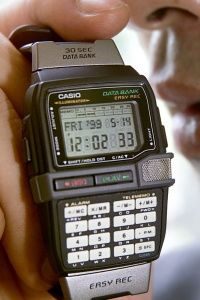
Wearable tech isn’t new. It’s just getting less clunky. You can trace the lineage of the smart watch back to the 1970s, when brands like Seiko, Pulsar, and Casio started cramming basic digital functions into wristbands. These early models could store data, do simple math, and run rudimentary games. Later, companies like Swatch, Fossil, and Microsoft tried their hand at the category, but none managed to build real momentum among consumers.
Today, the hardware is significantly better, even if the core concept hasn’t changed. Essentially, modern smart watches shrink smartphone features down to a size that fits on your wrist. Miniaturization is moving fast, and analysts are betting that this will finally push the technology into the mainstream.
NextMarket Insights predicts smart watch sales will explode from 14 million units in 2014 to 373 million by the end of 2020.
The industry is crowded. Samsung, Sony, Qualcomm, Motorola, Nissan, Adidas, and Timex all have products on the market. Toshiba, LG, and Blackberry are circling the wagons. Rumors were swirling in 2013 that both Google and Apple were preparing to enter the space aggressively.
If you look at operating system trends, the picture is clear. NextMarket Insights expects about half of all smart watch sales to run on Android. Given Google’s stranglehold on the smartphone market, it’s a logical step for them to dominate the wrist. Whether the hype will translate to actual sales volume remains the question. So far, buyer excitement has been muted, despite the presence of some capable devices.
Major Players and Operating System Dominance
The race to define the smart watch is getting serious, with corporate heavyweights betting on massive profit margins. The landscape is fragmented, but a few names stand out as the primary drivers of current availability and future growth.
Current market participants include:
– Samsung
– Sony
– Qualcomm
– Motorola
– Nissan
– Adidas
– Timex
Companies like Blackberry, Toshiba, and LG are also moving to capture market share. The anticipation of a Google or Apple entry was driving much of the speculation in 2013, signaling that the biggest tech players viewed the wrist as the next battleground for user engagement.
Why does Android matter so much here? Because it already wins on phones. If the smart watch follows the smartphone adoption curve, Android’s existing ecosystem and developer base give it a massive head start. It’s not just about the hardware; it’s about the software ecosystem that keeps users glued to their devices.
Current Limitations and Consumer Reality
Let’s be honest. Current smart watches don’t do anything groundbreaking. They don’t replace your phone. They mirror it. You get notifications, basic fitness tracking, and a few apps, but the experience is still limited by the smaller screen and processing power.
The buzz hasn’t translated to a flood of purchases yet. Many consumers are still waiting for a killer app or a significant leap in battery life and utility that justifies having another device on their body. The 2014 sales figure of 14 million units looks small next to the projected 373 million. That gap represents a massive amount of growth that needs to happen
Sony SmartWatch 2: The Android Ecosystem on Your Wrist
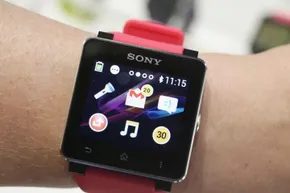
Sony’s entry into the space, the Sony SmartWatch 2, leans heavily into the Android experience. It sports a 1.6-inch square touchscreen, just 7.6 millimeters thick, supporting standard gestures like swipes and pinches. You get the choice between a digital readout or an analog-style face. Under the hood, it runs Android, which means the Google Play Store is wide open. At the time of its late-2013 release, Sony touted around 200 specific apps, though the library was growing.
The hardware supports NFC and Bluetooth. It’s water-resistant, charges via USB, and the battery lasts roughly four days under moderate use. Stylistically, Sony acknowledged that a smartwatch has to look like a watch. You can swap the factory rubberized band for any standard 24-millimeter strap.
Pairing with a compatible Sony smartphone unlocks the core utilities: rejecting calls, muting the ring, controlling music playback, and checking notifications from Facebook, Twitter, and SMS. If you have a Bluetooth headset, you can even take calls through the watch.
Pebble: E-Paper Efficiency and Minimalist Design
Pebble took a completely different approach. Instead of trying to be a smartphone on your wrist, it focused on battery life and style. The $150 device uses a monochrome e-paper display, similar to e-readers. This choice eliminates the power-hungry LCD backlight, allowing for weeklong battery life. The trade-off? No touchscreen. You navigate menus via side-mounted buttons.
The watch measures 5 centimeters long, 3.6 centimeters wide, and 10.2 millimeters thick. It packs an ARM Cortex-M3 processor and a 3D accelerometer, making it a solid partner for fitness apps like RunKeeper. It’s waterproof and works with both Android and iOS. Via Bluetooth 4.0, you can read message texts and control music. The company emphasized that the hardware was a foundation, with more features promised later.
Samsung Galaxy Gear: The Feature-Heavy Flagship
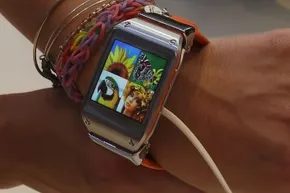
At $300, the Galaxy Gear was the premium option. It came loaded. A 1.9-megapixel camera for stills and video, a speaker, a pedometer, and voice command input. It had 4GB of storage and a 1.6-inch display, though it was thicker than its rivals at about 1.3 centimeters.
Samsung tailored specific apps to the hardware. They included a modified version of Evernote, designed to let you quickly pair photos with voice memos. It integrated smoothly with fitness trackers like Runtastic and RunKeeper. The depth of features made it a powerhouse for productivity and health tracking, assuming you had the budget.
Goophone Smart Watch: A Standalone Smartphone on Your Wrist
Goophone, a company previously known for selling counterfeit iPhones, released a smartwatch that defied the category standard. The Goophone Smart Watch wasn’t a companion device. It was a standalone smartphone.
It had built-in antennas, meaning you could make cellular calls without your phone attached. The 2G version cost $250; the 3G model was $300. Specs included a 1.5-inch screen, a 1.2GHz processor, 512MB of RAM, and a 2-megapixel camera.
The catch? It ran an older version of Android. This legacy OS meant newer apps often wouldn’t work. It was a niche device, essentially a small smartphone strapped to your wrist, rather than an extension of your primary phone.
Why your wrist isn’t quite ready for a computer
The tech hurdles remain steep, largely because human wrists are not expandable. You cannot simply scale up the hardware. The display stays small, forcing users who are used to massive smartphone panels to squint at a miniature interface. Developers face a similar squeeze. They have to build intuitive graphical elements into a square inch of real estate. For programmers, this constraint often makes or breaks the entire product experience.
Battery life doesn’t help the cause. Current lithium-ion tech cannot sustain a glowing screen with multiple active functions for long. You are charging within a few hours.
Then there is the style problem. A watch is a fashion statement. It signals how you dressed in the morning. Most early iterations looked like plastic bricks, clunky and loud enough to ruin a black tie outfit. Manufacturers have spent years trying to fix this “geek” aesthetic without losing functionality.
Shifting the burden from your hands
Why would anyone want this in the first place? Look around. Phones demand total attention. People stare into their devices like they are windows into their souls. A watch changes the dynamic. It is passive. It rests on your person rather than occupying your fingers.
A well-designed watch could reclaim some of the mental space currently overrun by smartphones. It is less intrusive. You check a notification without pulling out a brick of glass and metal. That shift in interaction is the real value proposition.
Who is winning the smart watch market right now
No single device has captured the mainstream imagination quite yet. Apple and Google are the heavyweights. Apple brings aesthetic refinement and deep integration with its ecosystem. Google leverages the Android user base and its financial resources. Both are rumored to have products that could finally strike industry gold.
Until then, the market is a bit of a fishery. Companies cast lines hoping to snag a following. Pebble, the underdog, proved it was possible. They sold over 250,000 units in their initial offering. If a small company can find a niche, the big players are certainly working to do the same.
The future is unclear. Watches might remain permanent accessories, tethered to phones. Or, better batteries and innovative interfaces might allow them to stand alone. Maybe the limited real estate is just too hard a hurdle for current tech to overcome.
Frequently asked questions about smart watches
Can you pair a smart watch with an Android phone?
Generally, yes. Most devices pair with either Android or iOS. Workarounds exist to pair an Apple Watch with an Android phone, but app compatibility suffers. It is safer to choose a watch designed for your phone’s operating system.
Which are the top smart watches in 2021?
The market leaders at that time were the Apple Watch Series 6, Samsung’s Galaxy Watch 3, and the Fitbit Sense.
What is the price range for smart watches?
Pricing varies wildly. The Letsfit Smart Watch sits at the bottom, around $30 on Amazon. The Apple Watch Hermès hits $1,299. Luxury models can approach $200,000, though that is an outlier.
Is a smart watch worth buying?
For most, yes. They offer wrist-based heart rate measurement, sleep tracking, activity monitoring, and GPS for distance. Modern designs are stylish, avoiding the clunky look of devices from five to ten years ago.
Which is the best cheap smart watch?
“Cheap” is relative in wearable tech. If you are budget-conscious, the Apple Watch Series 3 ($199), Samsung Galaxy Watch Active ($199), and Amazfit Bip ($70) are strong options.